One of the most common questions parents ask when their children begin learning Mandarin is:
Should children learn Pinyin first, or should they begin with Chinese characters?
Some parents assume that Pinyin works much like English phonics. If children can learn the sound system first, they may be able to “sound out” Chinese words independently.
Other parents worry that children who are already learning English phonics at school may become confused if they are introduced to another system using the same Roman letters but different pronunciation rules.
And many parents naturally ask:
If my child does not learn Pinyin first, how will they learn to read Chinese?
These are all reasonable questions.
But through years of teaching children growing up overseas, we at YouGuang Chinese School have become increasingly clear about one principle:
For many young children growing up in Canada, Mandarin does not necessarily need to begin with Pinyin.
For children who already understand or speak Mandarin at home, it can often be more effective to first build a direct connection between spoken language, meaning, and Chinese characters, and then introduce Pinyin systematically at the appropriate stage.
Pinyin matters.
But Pinyin is a tool.
The tool should serve the development of real Mandarin ability—not determine the entire learning sequence.
Why Do So Many Parents Assume Pinyin Should Come First?
The idea is understandable.
English reading depends heavily on relationships between letters and sounds.
Children learn phonics so that when they see written letters and letter combinations, they can attempt to decode a word.
When parents see Pinyin, it is therefore natural to make a comparison:
If children learn phonics before they can read English independently, shouldn't they learn Pinyin before they learn Chinese characters?
But there is an important difference.
English uses an alphabetic writing system.
The letters children learn through phonics are part of the actual written language.
Chinese is different.
Pinyin is a system for representing Mandarin pronunciation, but it is not the primary Chinese writing system.
Ultimately, children need to read:
苹果 — apple
学校 — school
朋友 — friend
中国 — China
春天 — spring
They do not ultimately read Mandarin through:
píng guǒ, xué xiào, péng you, zhōng guó, chūn tiān
Pinyin is valuable, but its role in Mandarin literacy is therefore not identical to the role phonics plays in English literacy.
So the better question is not simply:
“When should my child learn Pinyin?”
It is:
“When will Pinyin most effectively support the development of real Mandarin literacy?”
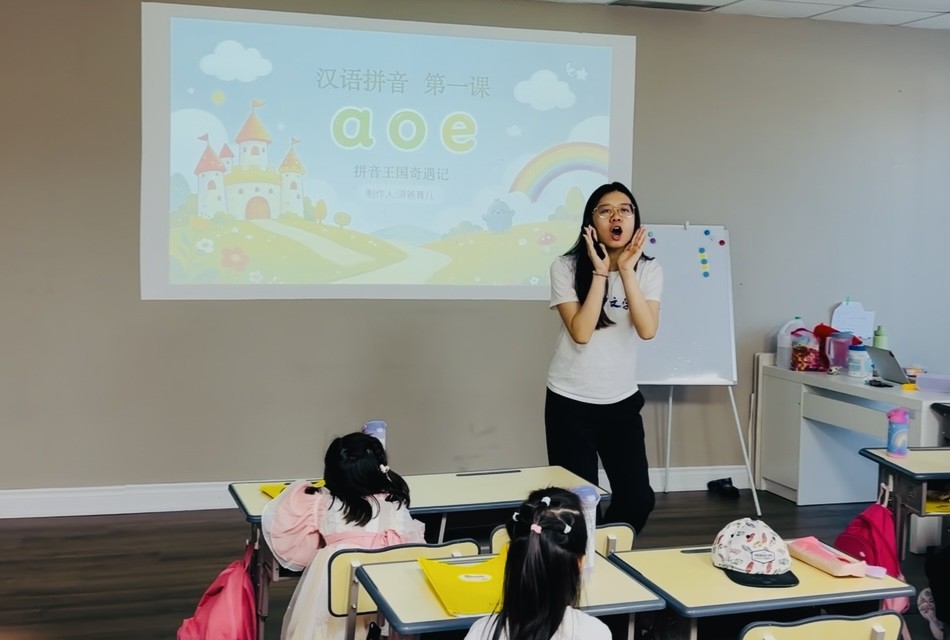
For Children Who Already Speak Mandarin, Characters Can Come Very Naturally
Imagine a five-year-old who regularly hears Mandarin at home.
The teacher shows the child the Chinese characters:
妈妈
The child may not recognize the characters yet, but the spoken word māma and the person it represents have already existed in the child's mind for years.
The new learning task is therefore to connect:
the familiar spoken word “妈妈” ↔ the written characters 妈妈
That connection can happen directly.
The child does not necessarily need to go through:
mā ma → 妈妈
first.
This is why, in YouGuang's early Mandarin programs, we place strong emphasis on connecting familiar spoken vocabulary directly with Chinese characters.
Words such as:
人 — person
口 — mouth
手 — hand
大 — big
小 — small
山 — mountain
水 — water
爸爸 — dad
妈妈 — mom
学校 — school
are already familiar to many children from Mandarin-speaking homes.
Their discovery is:
“The word I already know sounds like this—and this is what it looks like in Chinese.”
That is a powerful moment in early literacy development.
Chinese characters are no longer abstract symbols.
They become connected to language the child already possesses.
A Common Classroom Example: The Child Can Say the Word but Cannot Read It
This happens frequently in early Mandarin classrooms.
A teacher asks:
“What fruit do you like?”
A child confidently answers in Mandarin:
“I like apples.”
The child clearly understands and can use the spoken word.
But when the teacher shows:
苹果
the child may not recognize it.
The teacher can then make the connection:
“The word you just said—苹果—is written like this.”
Through stories, pictures, games, and repeated reading, the same word appears again and again.
Over time, the child stops depending on the picture and begins recognizing the written word directly.
What is developing here is not simple memorization.
The child is building a stable relationship between:
sound → meaning → Chinese characters
If large amounts of Pinyin are introduced too early, some children begin developing a different habit:
look at the Pinyin first, then guess the characters.
They may appear to be reading Chinese when they are actually reading Pinyin.
That is something we pay close attention to in teaching.
Being Able to Read Pinyin Is Not the Same as Being Able to Read Chinese
This distinction can easily be missed.
Consider the sentence:
小明今天去公园。
If every character has Pinyin printed above it, a child who knows Pinyin may read the sentence quite fluently.
To a parent listening nearby, it may sound impressive.
But remove the Pinyin:
小明今天去公园。
and the child may suddenly stop.
What happened?
The child may have successfully completed the task of:
decoding Pinyin
rather than:
reading Chinese characters.
These are not the same skill.
At YouGuang, we therefore believe:
Pinyin should not become a permanent crutch for Chinese reading.
It can help children confirm pronunciation, learn unfamiliar words, and eventually type Chinese.
But the long-term goal is for children to develop:
character → sound and meaning
directly.
Not:
character → Pinyin → sound → meaning
The second route contains an extra layer that children eventually need to outgrow if they are to become independent readers.
A Teaching Case: “I Can Read It with Pinyin, but Not Without It”
We sometimes meet children who previously used materials in which Pinyin appeared above almost every character.
With the textbook open, they can read surprisingly fluently.
But when the same vocabulary is written on the board without Pinyin, they suddenly struggle.
For example:
春天 — spring
When they see:
chūn tiān
春天
they may read it immediately.
But when they see only:
春天
they hesitate.
This often reveals that the child's most familiar reading pathway has become:
find the Pinyin first.
When teachers gradually reduce that dependence and encourage children to recognize words through repeated exposure in vocabulary, sentences, and stories, something important begins to change.
At first, reading may actually become slower.
But over time, familiar words begin to be recognized directly.
The child stops searching for Pinyin.
This may look less impressive than immediate fluent decoding in the short term, but it is often a much more important step toward genuine Chinese literacy.
Short-term fluency is not always the same as long-term reading ability.
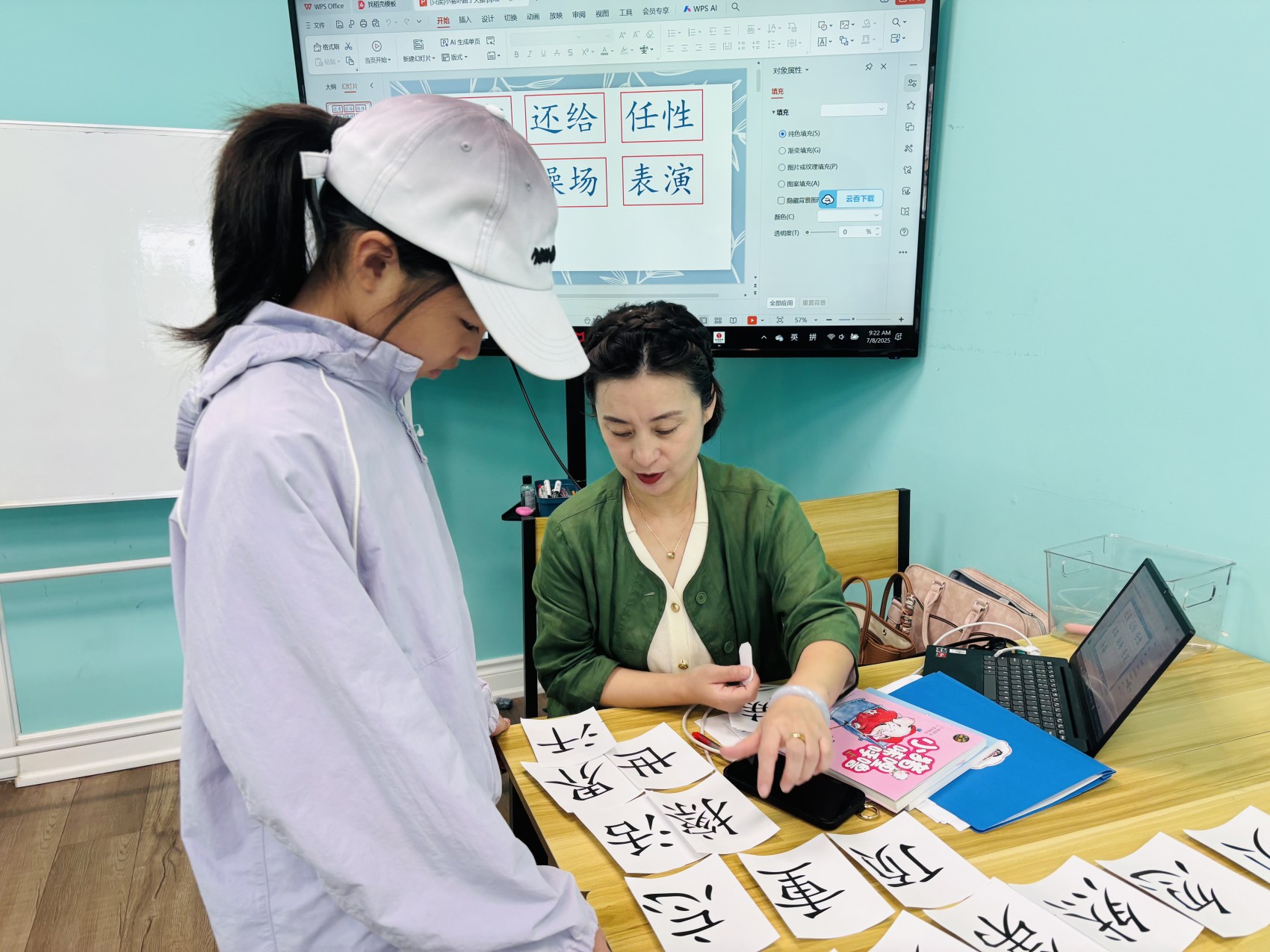
Does That Mean Pinyin Is Unimportant?
Not at all.
Pinyin is extremely useful.
The question is not whether children should learn it.
The question is:
When should they learn it, and what should they use it for?
Pinyin has several important functions.
It Helps Children Develop More Accurate Mandarin Pronunciation
Pinyin provides a systematic way to understand initials, finals, and tones.
This can be especially useful for children whose home Mandarin exposure is inconsistent or whose parents do not regularly speak standard Mandarin.
It Helps Children Learn Unfamiliar Words
As children's reading becomes more advanced, teachers cannot individually teach the pronunciation of every new character.
Pinyin can help children confirm pronunciation independently.
It Helps Children Type Chinese
For children growing up in a digital world, Pinyin input is an extremely practical skill for typing Mandarin on phones and computers.
It Helps Children Understand Mandarin Sound Patterns
Once children already have some Mandarin experience, systematic Pinyin instruction can make patterns they previously learned intuitively much clearer.
So Youguang is not opposed to Pinyin.
What we want to avoid is:
allowing Pinyin to replace Chinese characters.
When Is a Better Time to Introduce Pinyin?
For young children who already have a foundation in spoken Mandarin, we generally prefer to:
build some character recognition and early Chinese reading awareness first, then introduce Pinyin systematically at an appropriate stage.
Why?
Because by then, children already understand an essential idea:
Chinese is read through Chinese characters.
Pinyin is a tool that helps them.
It is not Chinese reading itself.
Once children already recognize a meaningful number of characters, have basic vocabulary, and are cognitively ready to understand a more systematic set of rules, learning:
initials,
finals,
tones,
and Pinyin combinations
can become much more efficient.
The child begins to understand:
“The Mandarin sounds I already know can be represented by this system.”
That is very different from asking a young beginner with limited Mandarin to mechanically memorize:
b, p, m, f
before those sounds are meaningfully connected to a language they understand.
Children from Non-Mandarin-Speaking Homes Need a Different Path
This distinction is essential.
Children from non-Mandarin-speaking homes should not automatically follow the same learning sequence as children who have heard Mandarin since birth.
Imagine a five-year-old from an English-speaking home entering a Mandarin classroom for the first time.
The child may not understand:
“Sit down.”
They may not know:
“apple.”
They may not yet be able to say:
“My name is…”
For this child, the first challenge is not Chinese character recognition.
It is building a basic Mandarin sound system, vocabulary, and comprehension.
In Youguang's classes for children from non-Mandarin-speaking homes, teachers may first use:
movement,
pictures,
songs,
gestures,
real objects,
context,
and repeated language.
For example, when children learn the song Two Tigers, some may initially understand very little of the Mandarin lyrics.
But through a familiar melody, gestures, actions, and repetition, they gradually understand the meaning of key phrases and words.
Language first becomes sound connected to meaning.
Characters and other supporting tools can then be introduced gradually.
For these children, Pinyin may play a somewhat larger supporting role at certain stages.
But it still cannot replace meaningful language input.
A child may be able to pronounce:
lǎo hǔ
perfectly.
But if the child does not know that lǎo hǔ means “tiger,” decoding the Pinyin has not yet created real language ability.
So even for non-Mandarin-speaking children, an important principle remains:
build sound and meaning first, then connect them to written language.
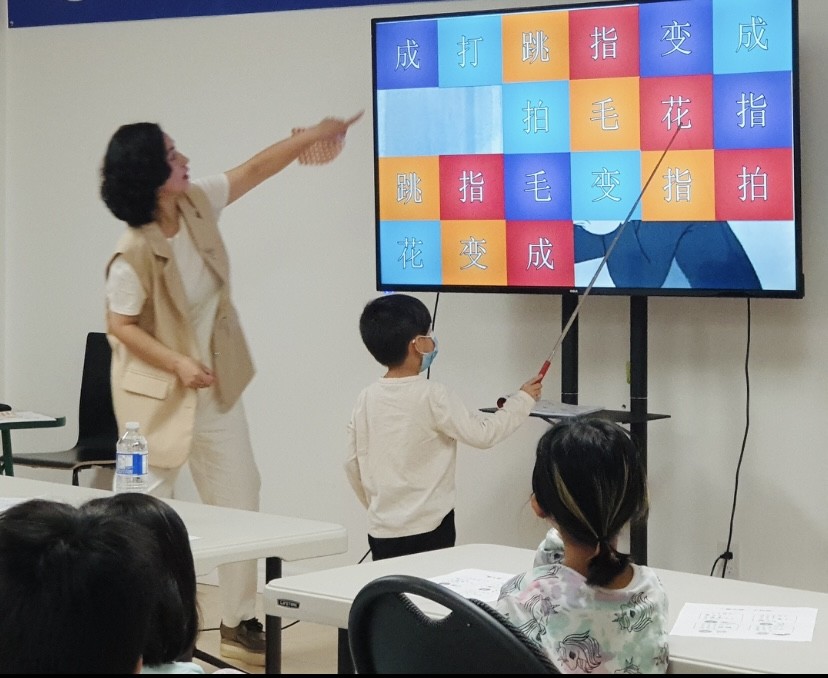
Will Pinyin Confuse Children Who Are Learning English Phonics?
This is another common concern for families in Canada.
Some Roman letters represent very different sounds in English and Pinyin.
For example, letters such as:
q, x, and c
do not follow the same pronunciation rules in Mandarin Pinyin as they do in English.
Temporary confusion can happen.
But that does not mean children are incapable of learning both systems.
Children can gradually understand that:
the same letter can represent different sounds in different language systems.
The more important issue is timing.
If a child is still at a very early stage of English phonics and is simultaneously asked to complete large amounts of mechanical Pinyin drills without meaningful Mandarin context, the additional cognitive load may not be necessary.
So the decision to introduce Pinyin should not be based only on age.
Parents and teachers should also consider:
How developed is the child's English reading?
How much spoken Mandarin does the child already understand?
Does the child recognize some Chinese characters?
Is the child cognitively ready to understand that two languages can use different sound systems?
That is why we do not believe every child should receive intensive Pinyin instruction at exactly the same age.
Chinese and English Use Different Reading Logic
Children growing up overseas often live between two writing systems.
English teaches them:
See letters → decode sounds.
Chinese gradually requires them to develop:
See a character or word → access sound and meaning directly.
These are different reading processes.
If Mandarin education simply copies the logic of English literacy, it can overlook the distinctive nature of Chinese characters.
Chinese characters certainly have internal patterns.
There are radicals.
There are phonetic-semantic relationships.
There are patterns in character construction.
But early literacy still requires children to build a large number of stable connections among characters, words, sounds, and meanings.
As literacy grows, children become increasingly able to use character patterns to learn unfamiliar vocabulary more efficiently.
So character learning at YouGuang is not about asking children to memorize every character as if it were an unrelated picture.
It is about building connections among vocabulary, context, repeated reading, meaning, and the structure of the Chinese writing system.
The Goal Is Not to Choose Between a “Pinyin Method” and a “Character Method”
Discussions about Pinyin sometimes become unnecessarily polarized.
One side says:
Pinyin must come first.
The other says:
Children do not need Pinyin at all.
We believe both positions are too simple.
The real educational question is not:
Which tool is always correct?
It is:
Which approach best supports this child at this stage?
For a four- or five-year-old who has heard Mandarin since birth, it may be most natural to first connect familiar spoken vocabulary directly to Chinese characters.
For an eight-year-old beginning structured study with stronger cognitive skills, Pinyin may quickly become an effective learning tool.
For a child who has never spoken Mandarin, the immediate priority may be basic comprehension and oral language before either Pinyin or character volume becomes the main concern.
Good education does not force every child into the same sequence simply because the sequence looks neat on paper.
What Ultimately Matters Is Whether Children Can Read Without Pinyin
So when parents ask us:
“Should my child learn Pinyin first or Chinese characters first?”
our answer is usually not a simple either-or.
For many young children who already have a foundation in spoken Mandarin, we generally prefer to help them first develop some direct character recognition and early reading awareness, then introduce Pinyin systematically at the right stage.
For children from non-Mandarin-speaking homes, we first need to build sufficient Mandarin sound, vocabulary, and comprehension, then gradually connect those foundations with characters and Pinyin according to the child's age and learning stage.
But whichever path a child follows, the long-term goal remains the same:
One day, the child should be able to read Chinese without depending on Pinyin.
Because authentic Chinese reading happens through Chinese characters.
When a child can open a Chinese book without Pinyin and continue reading independently;
when a familiar word produces meaning immediately without the child first searching for a pronunciation guide;
when Chinese characters begin to create sounds, ideas, images, and stories directly in the child's mind—
Mandarin is beginning to become truly theirs.
Pinyin can help children travel part of the journey.
But eventually, we want them to be able to move beyond that support.
From characters into reading.
From reading into understanding.
From understanding into expression.
That is the Mandarin ability we hope to build for children growing up overseas at Youguang Mandarin School.
Author: Guang Yang, Founder & Chief Educator of Youguang Mandarin School.