For families raising children outside a Chinese-speaking environment, choosing a Mandarin curriculum is not simply a matter of finding a “good textbook.” The more important question is whether the curriculum was designed for the realities of children growing up abroad: limited Chinese exposure, once-a-week classes, different home-language backgrounds, uneven parental availability, and the need to sustain motivation over many years.
In North America, Ma Liping Chinese has been one of the best-known heritage Chinese curriculum systems for decades. It made an important contribution by recognizing early that overseas Chinese children should not simply use a scaled-down version of mainland Chinese language arts. Its emphasis on direct character recognition, high-frequency review, delayed reliance on pinyin, and reading development influenced generations of teachers and families.
YouGuang’s in-house curriculum begins from many of the same realities, but it was developed in a different era and through a different set of classroom observations. The question we have tried to answer is not “How can we make Chinese easier?” but rather: How can we maintain ambitious long-term outcomes while designing a learning path that more children can realistically follow?
1. The Same Starting Point, but a Different Generation of Learners
Ma Liping Chinese was created for overseas heritage learners at a time when many children entering weekend Chinese school came from homes with relatively strong spoken Mandarin. Its curriculum therefore focuses heavily on turning existing oral language into literacy: recognizing characters efficiently, reading increasingly substantial texts, and later moving into writing, culture, and advanced Chinese.
That challenge still exists today, but the learner population has become more diverse. A modern Chinese classroom may include children from Mandarin-speaking homes, Cantonese-speaking homes, bilingual households, mixed-language families, and homes where very little Mandarin is used at all. Children also grow up in a much more visual and digital learning environment than they did thirty years ago.
For YouGuang, this means a curriculum must provide multiple entry points while still preserving a coherent long-term progression. It must support children who arrive with strong spoken Mandarin, but it must also be able to build confidence and foundational language for children whose Chinese exposure is much more limited.
2. Curriculum “Height” Matters — but So Does the “Slope”
One of the strengths of Ma Liping Chinese is its ambition. For students who can keep pace, the curriculum can build substantial character recognition and reading ability. That is a real achievement and one reason the program has remained influential.
At the same time, its own teaching materials openly acknowledge a pronounced increase in difficulty in Grade 2. The official Grade 2 guide states that “Grade 2 is the first year in which the difficulty of this curriculum increases,” and describes Grade 2 Chinese learning as a clear “hurdle.” The program’s teaching resources also describe Grade 2 as a stage in which students must “jump to pick the apple,” while the curriculum overview identifies Grade 2 as the point of greatest perceived difficulty.
This is an unusually candid and useful acknowledgement, because it highlights a fundamental curriculum-design question: should a long-term language program contain a sharp difficulty jump that students are expected to overcome, or should the same destination be reached through a more gradual sequence of smaller steps?
YouGuang has chosen the second approach. We think of curriculum design in terms of both height and slope. Height is the level students should ultimately reach. Slope is the path they must travel to get there. A high destination is valuable only if the learning path allows a broad range of capable children to continue moving toward it.
Our goal is therefore not to lower standards, but to distribute difficulty more carefully across levels. Character load, vocabulary, text length, reading complexity, writing expectations, and oral expression should rise continuously rather than suddenly. We want students to encounter challenge, but also repeated evidence that they can succeed.
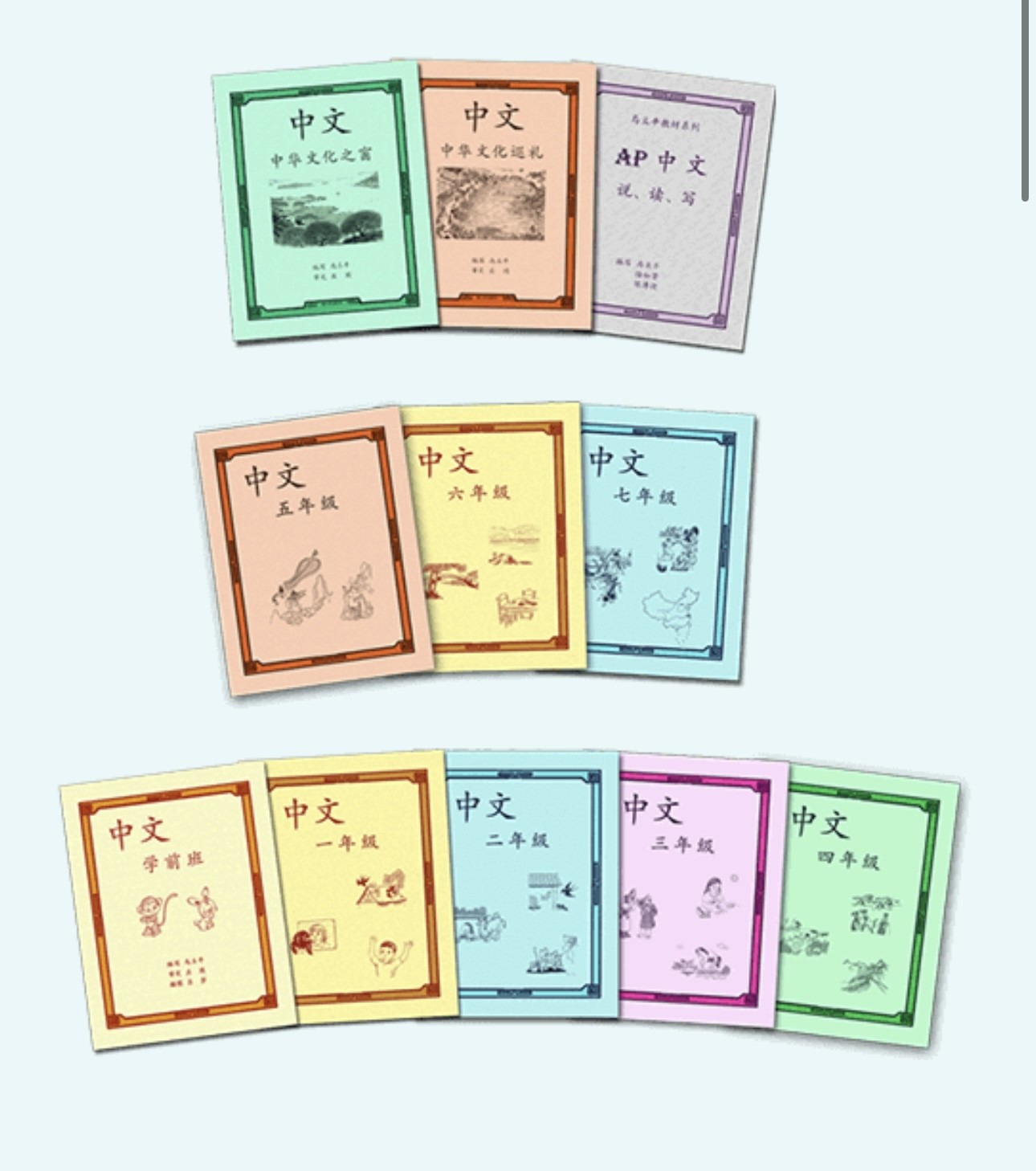
Ma Liping's textbook
3. A Strong Curriculum Should Work for More Than the Strongest Students
Any demanding curriculum will naturally showcase its strongest graduates. But a school also needs to look at the students who struggle, lose confidence, or leave.
When only highly academic children, children with strong Chinese home environments, or families able to provide extensive daily support can thrive, it is worth asking whether the program is measuring children or filtering them.
At YouGuang, we want advanced students to be challenged. But we also believe that ordinary learners deserve a curriculum in which progress is visible and sustainable. A child who repeatedly experiences “I can read this,” “I understand this,” and “I can say this in Chinese” is much more likely to remain engaged for the years required to build real literacy.
This leads to one of our core curriculum principles: a strong overseas Chinese program should not be judged only by how far its top students can go. It should also be judged by how many capable, ordinary children it can help keep learning.
4. Parents Matter — but They Should Not Have to Become the Second Teacher
Family support is enormously valuable in heritage language learning. Parents who speak Chinese at home, read with their children, and encourage regular use of the language create an environment no weekend school can fully reproduce.
The question, however, is how much of the instructional burden a curriculum assumes the family will carry.
Ma Liping’s Grade 2 teaching resources, for example, explicitly place a large amount of reading accumulation outside the classroom, with students completing reading at home and teachers checking it later. The official Grade 2 guide also notes that teachers and parents need to work together to help students cross this stage of increased difficulty.
For families with the time, language ability, and confidence to provide that support, the model can work very well. But many families today do not fit that profile. Parents may work long hours. Only one parent may speak Chinese. Some parents speak Chinese fluently but do not know how to teach literacy. Others are raising children in homes where Mandarin is not the family language at all.
YouGuang’s position is that parents should support learning, but the core instructional responsibility should remain with the school and the curriculum. Homework should reinforce and extend what has already been taught effectively, rather than requiring parents to reteach the lesson at home.
5. Our Own Experience Using Ma Liping Chinese
YouGuang’s perspective on these questions is not based only on observation from the outside. In our first year as a school, we used Ma Liping Chinese ourselves.
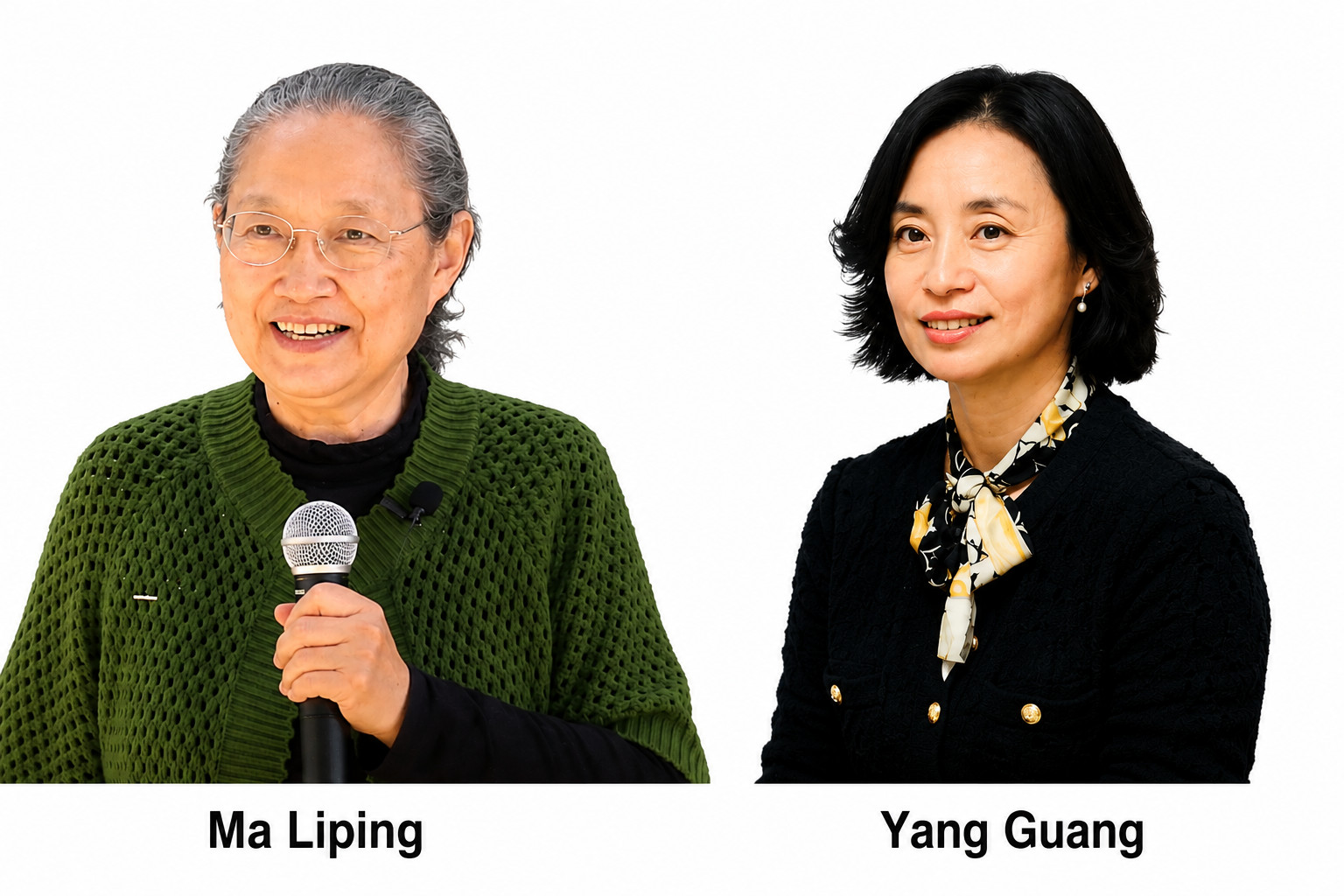
Yang Guang, YouGuang’s founder and chief curriculum designer, taught with the materials directly. That experience allowed us to see both why the curriculum had earned its reputation and where it did not fit the broad range of children in our own classrooms.
Students with strong spoken Chinese, quick character recognition, strong study habits, and substantial family support often did very well. But we also saw capable children begin to struggle when the learning curve became steeper and home reinforcement became more important.
That year did not lead us to conclude that Ma Liping Chinese was a poor curriculum. It led us to a more useful conclusion: even a respected curriculum may not be the right curriculum for every school, every family, or every child.
It was one of the experiences that pushed us to begin developing our own system.
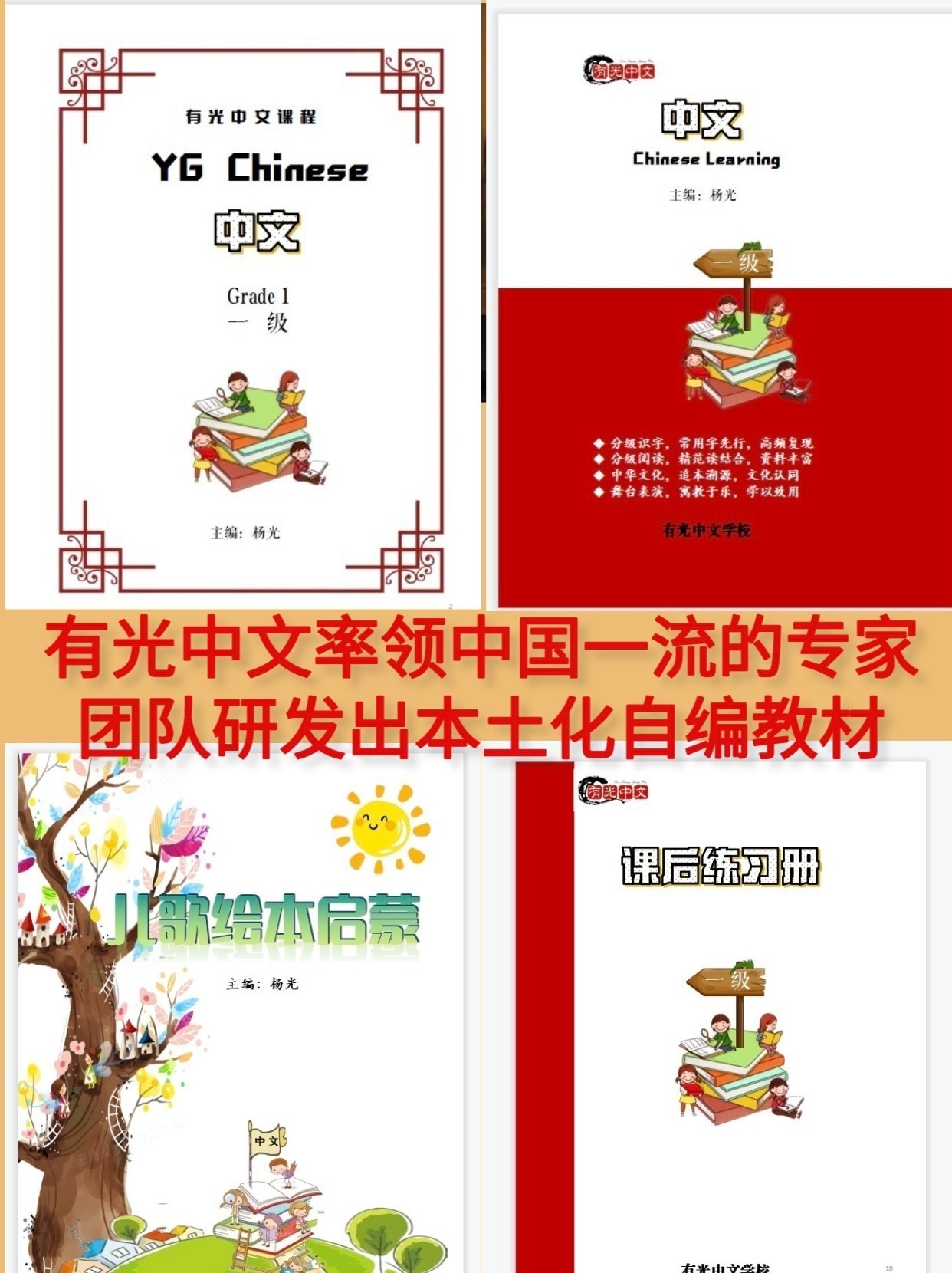
YouGuang Mandarin's Textbooks
6. Starting Earlier: Language Interest Before Formal Literacy
Ma Liping Chinese does have a preschool/K curriculum, and its preschool materials were specifically created for children under six. That is important to recognize. The difference is therefore not that one system has early-childhood materials and the other does not.
The distinction is in emphasis. YouGuang treats the four-to-six-year-old stage as a substantial curriculum phase in its own right, not simply as preparation for formal character learning.
At this age, we focus heavily on listening, speaking, rhythm, stories, movement, picture books, play, and interaction. Children begin connecting sound, meaning, and written Chinese, but the first priority is to build a positive relationship with the language.
For a four-year-old, “I want to hear this story again,” “I want to sing this song,” or “I want to say this in Chinese” can be as important as the number of characters recognized. A child who develops affection, confidence, and language intuition at four or five has a stronger foundation for literacy later.
7. Visual Design Is Part of the Learning Experience
Traditional heritage Chinese textbooks have often prioritized text density and literacy efficiency. Many core Ma Liping materials use a comparatively text-heavy, restrained visual presentation, although newer preschool materials have incorporated bright color and more visual support.
There is nothing inherently ineffective about a simple page. For older or highly motivated learners, reduced visual complexity can help concentrate attention on text.
But young children today encounter richly designed picture books, school materials, apps, and digital media from an early age. For them, the visual experience of a textbook affects whether the material feels approachable before the lesson even begins.
YouGuang therefore uses full-color design throughout its in-house materials. Color is not intended as decoration for its own sake. Layout, illustration, typography, and visual hierarchy should help children understand content, navigate the page, and feel that a Chinese textbook is something they want to open.
A children’s textbook should not only answer, “How will the teacher teach this?” It should also answer, “What does the child experience when the book is placed in front of them?”
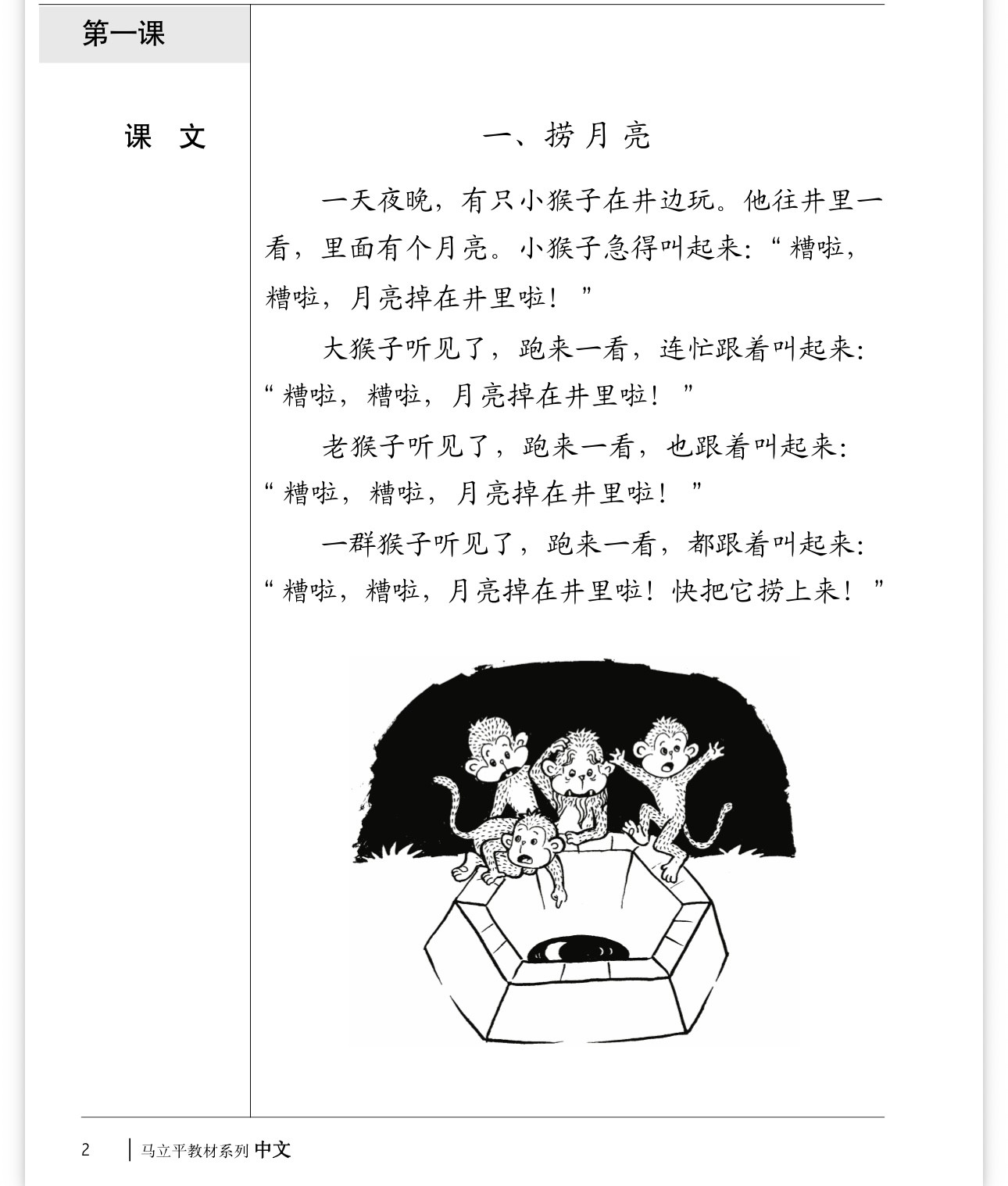
Above: Interior pages from the Ma Liping Mandarin textbooks.
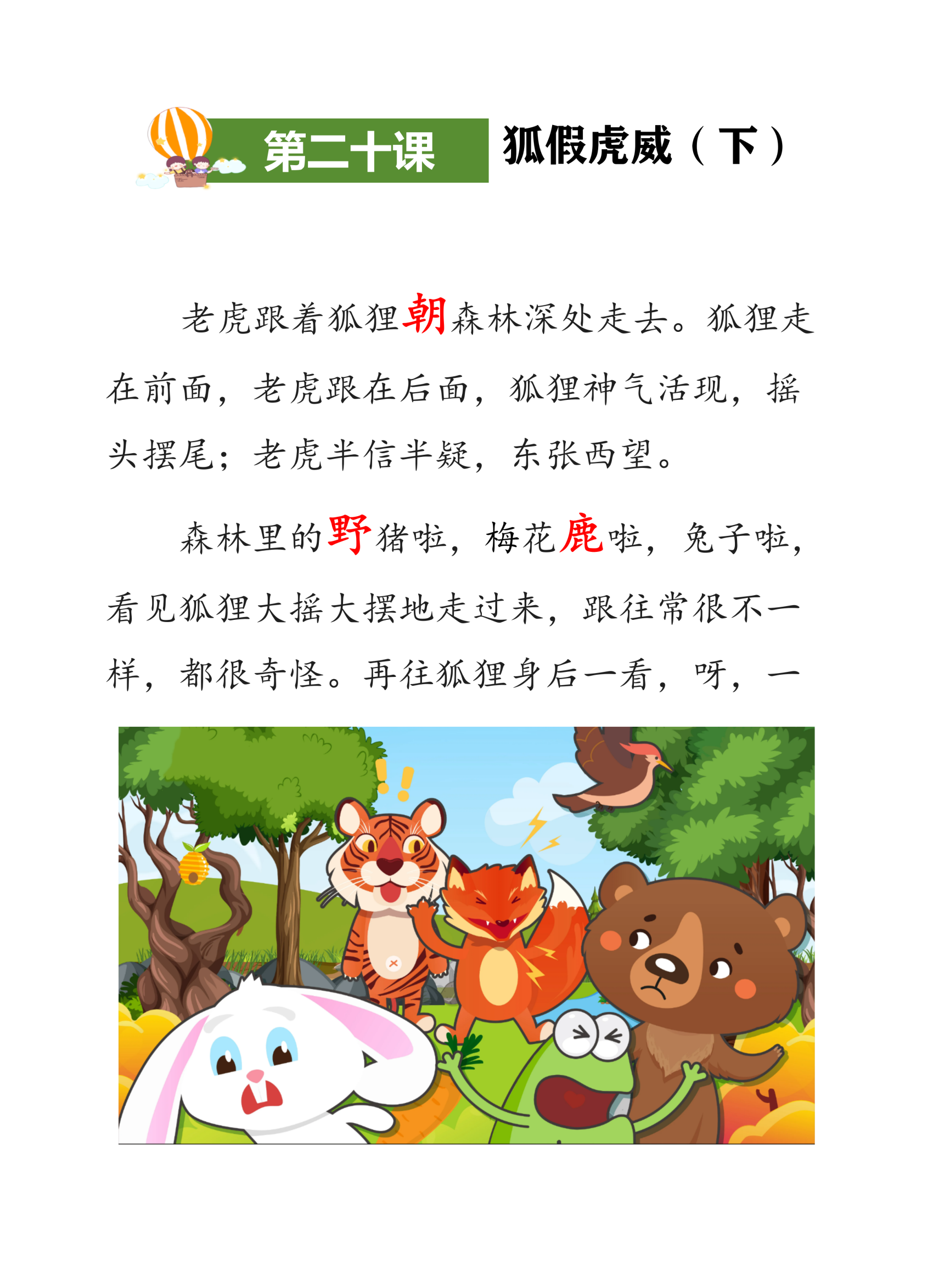
Above: Interior pages from the YouGuang Mandarin textbooks.
8. Classics Matter — and So Does the Present
Ma Liping Chinese has long placed substantial value on Chinese history, mythology, classical stories, traditional culture, and major literary works. That cultural dimension is one of the strengths of the program, especially for children growing up far from a Chinese-speaking society.
YouGuang shares the belief that heritage learners should encounter Chinese classics, poetry, fables, historical stories, and cultural traditions. But we also believe a modern curriculum must connect Chinese with the world children live in now.
Children today think about friendship, school, family, technology, cities, nature, the environment, creativity, and an increasingly global world. Contemporary children’s literature and modern informational texts can provide language that feels immediately relevant while still building literacy.
Our approach is therefore not tradition versus modernity. It is both. Classics should not disappear, but the present should not be absent. A living language should help children understand where they come from and also give them words for the life they are living now.
9. Character Recognition Must Become Independent Reading
On this point, YouGuang and Ma Liping Chinese share important common ground. High-frequency characters should appear early. Previously learned characters need repeated exposure. Pinyin should not become a permanent crutch. Most importantly, character recognition must eventually become reading.
In YouGuang’s main literacy levels, approximately 300 core characters are systematically developed at each level. But “300 characters learned” is not the outcome we care about most. The real question is whether those characters become usable reading vocabulary.
Characters therefore reappear in words, sentences, core texts, and leveled reading passages. After major lessons, students encounter reading material designed largely from characters they already know, with only a small number of unfamiliar items that do not prevent comprehension.
We want children to experience independent Chinese reading as early as possible: “I can read this by myself.” Once that happens, Chinese learning begins to extend beyond the classroom because reading itself becomes a source of further language input.
10. From Reading to Expression
Literacy is essential, but recognizing characters and understanding a text are not the final goals of language education.
A child may know many characters and still struggle to tell a story, explain an idea, ask a question, or express an opinion in Chinese. For this reason, YouGuang increasingly integrates oral expression and structured language output into the curriculum.
Younger students describe pictures, answer questions, retell stories, sing, perform, and participate in role-play. As they grow, they move toward longer narration, reading response, open-ended questions, discussion, presentation, and increasingly structured writing.
Drama, recitation, storytelling, and classroom discussion are therefore not “extra activities” added after the textbook. They are part of the language curriculum itself.
The ultimate test of language learning is not simply “How much Chinese has this child studied?” but “What can this child actually do in Chinese?”
11. A Curriculum Designer Who Remains in the Classroom
One of the most distinctive features of YouGuang’s curriculum development model is the short distance between the curriculum designer and the classroom.
Yang Guang continues to teach children directly while leading curriculum development and teacher training. This matters because curriculum problems become visible immediately.
Is a character being introduced too early? Are two easily confused characters placed too close together? Is a reading passage unexpectedly difficult? Does an activity actually produce the language output it was designed to produce? Are children engaged, or merely completing the task?
These questions do not have to travel through a long chain of external adoption and feedback. They can move directly from classroom observation to teacher discussion, curriculum revision, and another round of classroom testing.
Our cycle is simple: classroom observation, teaching feedback, curriculum analysis, revision, and classroom validation.
For this reason, we do not think of our textbooks as finished products. They are part of a living instructional system. As long as we are teaching children, we expect the curriculum to keep improving.
12. Beyond the Textbook: Building a Complete Learning System
YouGuang’s goal is not simply to publish a set of books. The broader project is to build a coherent Mandarin learning system from approximately age four through Kindergarten, Grades 1–8, and advanced study.
The system includes textbooks, workbooks, handwriting practice, leveled reading, online assignments, classroom lesson design, and oral-expression training. Each component serves a different role: classroom teaching builds understanding and interaction; practice consolidates skills; handwriting develops written control; leveled reading expands input; online work maintains contact with Chinese between classes; and expression training turns acquired language into usable communication.
For children who may attend Chinese school only once a week, this connection between classroom and home is especially important. The curriculum must make two hours of class count, while also creating realistic ways for learning to continue between lessons.
Conclusion: Not the Hardest Curriculum, but the Right Path to a High Level
Ma Liping Chinese deserves recognition for its contribution to North American heritage Chinese education. It helped establish the principle that children growing up abroad need a curriculum designed for their own linguistic reality, and its work in character recognition, reading, and heritage education has influenced the field for decades.
YouGuang’s in-house curriculum is not an attempt to erase that history. It is a continuation of the same larger question in a new generation.
Today we ask not only how high a curriculum can go, but whether its slope is sustainable; not only what top students can achieve, but whether ordinary children can keep progressing; not only how many characters students recognize, but whether they can read independently and express themselves; not only how much parents can do at home, but how much responsibility a professional school should carry; not only how to preserve classics, but how to connect Chinese with the world children live in today.
We are not looking for the hardest Mandarin curriculum.
We are trying to build a path that allows more children growing up abroad to enjoy Chinese, learn it successfully, stay with it for years, and ultimately make the language their own.
Source Note
• Ma Liping Chinese Grade 2 Guide: describes Grade 2 as the first year of increased difficulty and a clear learning “hurdle.”
• Ma Liping Chinese Grade 2 Teaching Resources: describes the stage as one in which reading volume and character-learning difficulty increase significantly, with substantial reading completed at home.
• Ma Liping Chinese Curriculum Overview: states that Grade 2 has the greatest perceived difficulty in the program’s learning-difficulty curve.
• Ma Liping Chinese Preschool Materials: confirms the existence of a preschool/K curriculum and notes that newer preschool materials include vivid color.
Author: Guang Yang, Founder and Chief Teacher of YouGuang Chinese School, and Lead Curriculum Developer and Editor-in-Chief of YouGuang’s In-House Mandarin Curriculum.